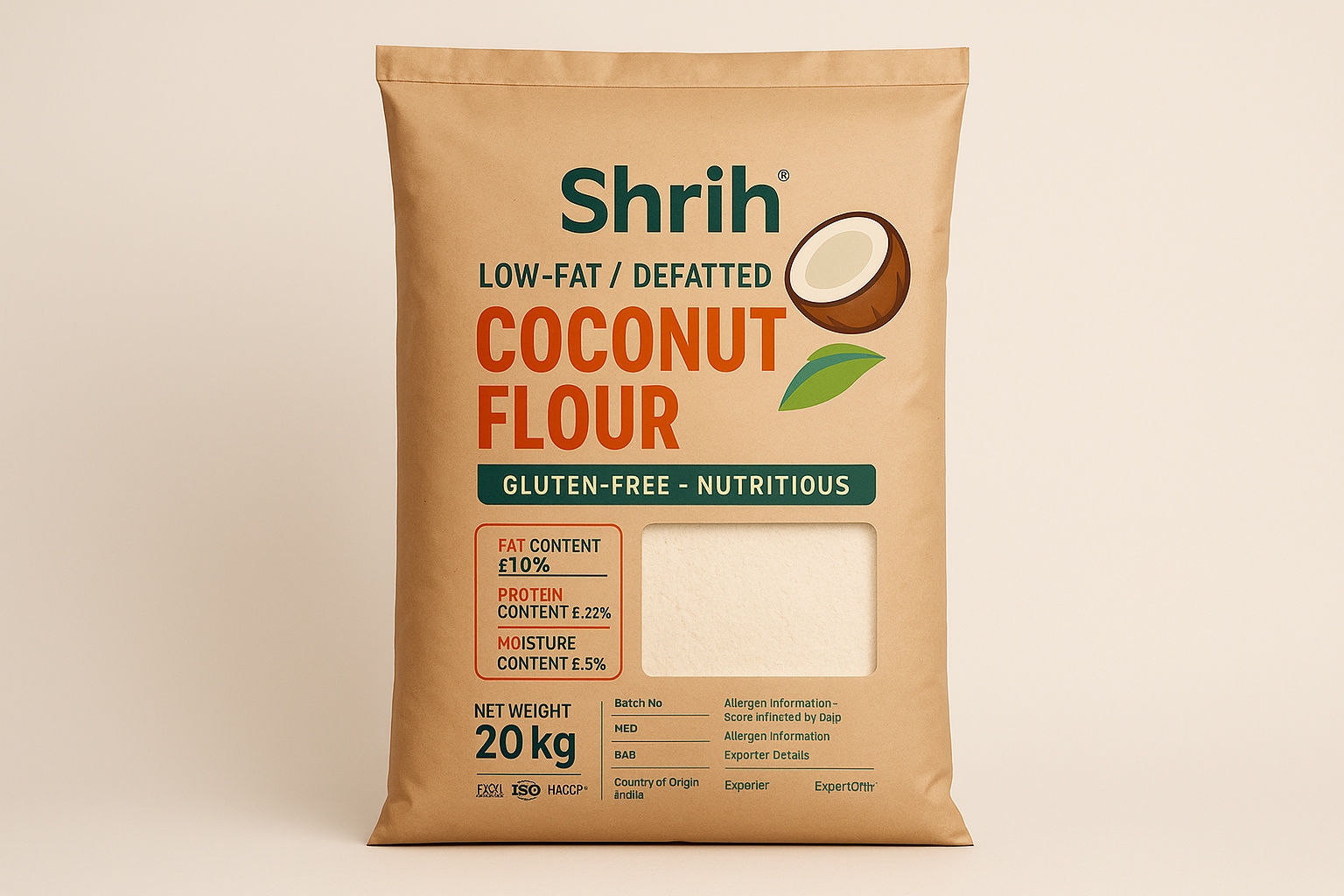
Low-fat defatted coconut flour in 20 kg export packing.
Gluten-free coconut powder for bakeries and food brands.
Shrih Foods supplies bulk and private label coconut flour.
Low-Fat Defatted Coconut Flour Exporter From India
Global food buyers are increasingly sourcing clean, safe, gluten-free and high-fibre flour ingredients for retail shelves, bakeries, food manufacturing, health food brands and private label grocery programs. Among these ingredients, low-fat defatted coconut flour has become a high-demand product because it supports gluten-free baking, keto-friendly foods, fibre-rich recipes, protein foods and clean-label product development.
The uploaded product image shows a Shrih low-fat / defatted coconut flour 20 kg laminated bulk bag, designed for wholesale and export buyers. The bag highlights gluten-free and nutritious positioning, with visible quality indicators such as fat content, protein content, moisture content, batch information, allergen information, certification icons and country-of-origin details. This visual language is important for importers, distributors, supermarkets, food manufacturers and HoReCA buyers who need reliable ingredient supply instead of inconsistent commodity sourcing.
Shrih Foods – Shrih Pulses & Food Grains™ is a certified Indian manufacturer and exporter of premium pulses, rice, flours, millets and soy proteins. With FSSAI, ISO 22000, HACCP and APEDA certifications, Shrih Foods supplies pure, safe and sustainable food grains to buyers across 25+ countries. The brand philosophy, Harvesting Quality. Nourishing the World., reflects a strong focus on food safety, sourcing reliability, processing discipline and export-ready packaging.
What Are Low-Fat Defatted Coconut Flour Products?
Low-fat defatted coconut flour is a processed flour made from coconut after oil extraction. It is typically dried, milled and processed into a fine powder suitable for food manufacturing, baking, health food applications and retail grocery supply. Compared with regular coconut powder, defatted coconut flour is generally positioned as lower in fat and useful for high-fibre, gluten-free and health-focused food products.
Buyers also search for this product as gluten-free coconut flour, coconut powder, coconut meal flour, coconut fibre flour, coconut baking flour, high-fibre coconut flour, low-fat coconut powder and food-grade coconut flour.
Commercially, this product is valuable because it serves multiple markets. Bakeries use it in gluten-free baking mixes. Health food brands use it in keto, paleo and fibre-rich products. Food manufacturers use it in snack formulations, biscuits, breakfast products, protein bars and clean-label recipes. Retail chains and supermarkets use it as a packaged flour product for health-conscious consumers.
Popular Names, Available Sizes And Grades
Low-fat defatted coconut flour is known by different names across global food markets. Importers, distributors and food manufacturers may search for it as defatted coconut flour, low-fat coconut flour, gluten-free coconut flour, coconut powder, coconut meal flour, coconut fibre flour, desiccated coconut flour, coconut baking flour, high-fibre coconut flour, bakery coconut flour, bulk coconut flour and private label coconut flour.
Shrih Foods can supply coconut flour in all required sizes, retail packs, wholesale bags, institutional formats, private label packaging and export-ready bulk packing as per buyer requirement.
Common packing options include 250 g, 500 g, 1 kg, 2 kg, 5 kg, 10 kg, 20 kg laminated bag, 25 kg bulk export bag, 50 kg wholesale sack, carton packing, palletized packing and container-load supply. For retail chains and private label grocery brands, Shrih Foods can support shelf-ready pouches, printed packs, barcode labels, batch coding and nutritional label coordination. For food manufacturers and HoReCA buyers, bulk bags and institutional formats are commonly preferred.
Different grades are available based on buyer requirement. Coconut flour can be supplied as premium grade, export grade, low-fat grade, defatted grade, gluten-free grade, bakery grade, food processing grade, retail grade, wholesale grade, HoReCA grade, ingredient grade and economy grade. Grades may vary based on colour, texture, mesh size, fat level, protein level, moisture level, fibre level, packing format and destination market expectations.
Most Popular Export Quality Specifications For Coconut Flour
The most popular export and wholesale quality for defatted coconut flour generally focuses on clean appearance, fine powder texture, controlled moisture, mild coconut aroma, low foreign matter and safe food-grade packaging.
A commercially useful buyer specification may include cream-white to off-white colour, fine or medium mesh texture, low-fat / defatted profile, controlled moisture for shelf life, natural coconut flavour, food-grade raw material, low foreign matter and export-safe laminated packing.
The image shows a 20 kg laminated bag with quality indicators such as Fat Content ≤10%, Protein Content ≥22% and Moisture Content ≤5.5%. These values help communicate ingredient performance to food manufacturers, bakeries and bulk buyers, though final specifications should always be confirmed based on buyer requirement and agreed commercial terms.
Final product specification, grade, moisture level, purity, size, packing and documentation can be customized according to buyer requirement, shipment volume, destination country and agreed commercial terms.
Visual And Product Quality Language Of Coconut Flour
The product image communicates a clean export ingredient identity. The kraft laminated bag gives a natural, sustainable and bulk supply impression. The transparent window shows a fine, light-coloured flour texture, which supports visual trust for buyers who want clean and consistent product appearance.
The coconut icon and leaf graphic create a natural food product identity. The “gluten-free” and “nutritious” label supports health food positioning. The 20 kg net weight makes the product suitable for wholesale distributors, food factories, bakeries, HoReCA kitchens and institutional procurement teams.
For international buyers, this type of packaging suggests export readiness, food safety awareness, batch traceability and practical bulk handling.
Nutritional, Culinary And Ingredient Value Of Coconut Flour
Coconut flour is popular because it supports gluten-free, high-fibre and health-focused food development. It is used in bakery mixes, pancakes, cookies, biscuits, bread alternatives, keto foods, paleo foods, protein snacks, smoothies, breakfast blends and clean-label packaged foods.
For food manufacturers, coconut flour can be used as a functional ingredient where fibre, texture, mild coconut flavour and gluten-free positioning are required. For supermarkets and e-commerce grocery sellers, it appeals to consumers looking for healthier flour alternatives. For HoReCA kitchens, it can support gluten-free menu development and premium bakery applications.
Where Low-Fat Coconut Flour Is Used
Low-fat defatted coconut flour is used across retail, wholesale and industrial food channels. Common usage environments include supermarkets, hypermarkets, ethnic grocery stores, health food stores, e-commerce grocery catalogs, bakery factories, snack manufacturing units, biscuit plants, protein food brands, plant-based food companies, hotels, restaurants, catering kitchens, cloud kitchens, institutional kitchens and food export warehouses.
It is also suitable for private label grocery brands that want to launch gluten-free flour products under their own label.
Industries And Buyer Groups That Need Coconut Flour
The strongest buyer groups for coconut flour include importers, wholesale distributors, flour distributors, supermarket chains, hypermarkets, Indian grocery chains, health food brands, keto food brands, gluten-free product companies, bakery manufacturers, snack manufacturers, ready-to-eat food companies, protein food manufacturers, HoReCA procurement teams, hotels, restaurants, caterers, institutional buyers, private label grocery brands, e-commerce grocery sellers and global procurement teams.
Shrih Foods supports these buyer groups with product consultation, grade selection, buyer-specific packing, sample coordination, export-ready packaging and documentation support.
Why Coconut Flour Attracts Buyer Attention
Low-fat defatted coconut flour attracts buyer attention because it fits multiple consumer trends at the same time: gluten-free eating, high-fibre diets, clean-label products, natural ingredients, plant-based nutrition, keto recipes and healthier bakery alternatives.
From a commercial viewpoint, it is attractive because it can be sold as a retail grocery product, used as an industrial ingredient or packed under private label brands. Its long shelf-life potential, light weight, dry powder format and bulk bag suitability make it practical for international trade.
Processing, Cleaning, Sorting And Quality Control
For coconut flour, quality depends on raw material selection, oil extraction control, drying, milling, sieving, texture control, moisture management, hygienic handling and packing. Shrih Foods follows a buyer-focused approach across sourcing, processing, cleaning, sorting, packaging and export coordination.
The company’s broader product network includes pulses manufacturing, rice supply and export, flour milling and packaging, millet cleaning and processing, soy protein ingredient supply and bulk agro commodity export. This allows buyers to source multiple Indian food grain categories through one supplier.
Food safety systems such as FSSAI, ISO 22000, HACCP and APEDA support create confidence for importers, distributors and food manufacturers looking for certified Indian food products.
Design, Manufacturing, Sourcing And Export Process
A typical coconut flour export supply process begins with buyer inquiry review and specification understanding. Shrih Foods can help identify the required grade, packing format, target market, usage application, label requirements and shipment volume.
After specification finalization, product sourcing and processing are aligned with buyer needs. Coconut flour can be packed in retail pouches, laminated bags, PP/BOPP bags, cartons, pallets or bulk export formats. For private label projects, buyer artwork, barcode, nutritional panel, batch coding and export markings can be coordinated.
The Mundra export and logistics division supports container dispatch planning, port-based shipment coordination and export documentation assistance.
Safety, Shelf Life, Packaging And Performance
Food safety and shelf life are major priorities for flour exports. Coconut flour needs moisture-controlled packing, hygienic handling, strong bag sealing and safe storage conditions. Laminated bags, as shown in the image, are suitable for bulk export and wholesale supply because they help protect the flour during warehousing, handling and container movement.
Shrih Foods can support buyer-specific packaging options including retail pouches, private label packs, master cartons, laminated bags, 20 kg bags, 25 kg bags, 50 kg sacks, palletized export packing, barcode labeling, batch coding, product stickers, shipping marks and nutritional label support.
For selected shipments, documentation support may include product specification sheet, COA where applicable, phytosanitary certificate where applicable, fumigation certificate where applicable, country of origin documentation, invoice, packing list and pre-dispatch inspection support.
Why Global Buyers Invest In Indian Coconut Flour
Global buyers invest in Indian coconut flour because India offers strong agro processing capability, cost-effective manufacturing, experienced export logistics and a growing ecosystem for certified food grain and flour supply. Buyers also prefer India-made food ingredients because of the availability of multiple product categories such as pulses, rice, flours, millets, soy proteins and food grains from one export partner.
For importers and distributors, this improves procurement efficiency. For supermarkets, it supports retail-ready product development. For food manufacturers, it provides consistent ingredient sourcing. For private label brands, it creates scope for custom packaging and market-specific product launches.
Shrih Foods / ShrihFoods.com Expertise
Shrih Foods – Shrih Pulses & Food Grains™ is a certified Indian manufacturer and exporter of premium pulses, rice, flours, millets and soy proteins. With FSSAI, ISO 22000, HACCP and APEDA certifications, Shrih Foods supplies pure, safe and sustainable food grains to buyers across 25+ countries.
The Mumbai corporate office manages buyer communication, commercial coordination, documentation support and catalog development. The Indore processing and packaging unit supports flour, pulse and soy processing requirements. The Jodhpur grain cleaning and sorting facility supports millet and dry grain processing. The Mundra export and logistics division supports container dispatch and port-based shipment coordination.
This multi-location model helps Shrih Foods serve importers, distributors, food manufacturers, supermarkets, HoReCA buyers and private label brands with consistent, export-ready supply.
Complete Wholesale And Export Supply Capability
Shrih Foods supports complete wholesale and export supply capability for coconut flour and other food grain products. This includes product consultation, buyer specification review, grade selection, sourcing, processing, cleaning, sorting, milling where applicable, quality control, packing, private label packaging, bulk export packing, export documentation support, logistics coordination and container dispatch.
In addition to coconut flour, Shrih Foods works across rice, basmati rice, non-basmati rice, flattened rice, puffed rice, wheat grains, maize, wheat bran, barley, wheat flour, gram flour, maida flour, rice flour, corn flour, maize flour, soya flour, multigrain flour, barley flour, amaranth flour, malt flour, millets, soybean protein isolate, soybean protein concentrate, textured soy protein, TSP, TVP and defatted soy flour.
Future Of Coconut Flour And Gluten-Free Flour Sourcing
The future of coconut flour is linked to gluten-free diets, clean-label bakery products, fibre-rich foods, plant-based nutrition, private label grocery growth and health food innovation. Retail chains, food brands and e-commerce sellers are expected to continue expanding gluten-free and better-for-you product ranges.
Certified sourcing, traceable supply, safe packaging and buyer-specific customization will become increasingly important. Shrih Foods is positioned to support this demand through India-based sourcing strength, processing coordination, export packaging and global buyer servicing.
Commercial Conclusion
For importers, wholesale distributors, retail chains, supermarkets, food manufacturers, snack producers, bakeries, health food brands, plant-based food companies, HoReCA buyers, hotels, restaurants, caterers, institutional buyers, private label grocery brands, e-commerce sellers, commodity traders and global procurement teams, Shrih Foods offers a reliable India-based supply solution for low-fat defatted coconut flour.
With certified food safety systems, export-ready packaging, buyer-specific grades, all-size packing options and multi-location support across Mumbai, Indore, Jodhpur and Mundra, Shrih Foods helps global buyers source coconut flour and related food grain products with consistency, safety and trust.
FAQ Section
1. What is low-fat defatted coconut flour?
Low-fat defatted coconut flour is a processed coconut-based flour made after oil extraction, drying and milling. It is commonly used in gluten-free baking, health foods and food manufacturing.
2. What are the popular names for coconut flour?
It is also known as defatted coconut flour, low-fat coconut flour, gluten-free coconut flour, coconut powder, coconut meal flour, coconut fibre flour, coconut baking flour and high-fibre coconut flour.
3. Where is coconut flour used?
Coconut flour is used in bakeries, gluten-free food products, keto foods, biscuits, snacks, breakfast mixes, protein foods, smoothies, retail grocery packs and private label products.
4. Who needs bulk coconut flour?
Importers, distributors, supermarkets, bakeries, food manufacturers, health food brands, HoReCA buyers, private label brands and e-commerce grocery sellers need bulk coconut flour.
5. Is coconut flour available in all sizes?
Yes. Shrih Foods can supply coconut flour in retail packs, wholesale bags, HoReCA packs, institutional packs, 20 kg bags, 25 kg bags, 50 kg bags, private label packs and buyer-specific export packing.
6. Is coconut flour available in different grades?
Yes. Coconut flour is available in multiple grades such as premium grade, export grade, low-fat grade, defatted grade, bakery grade, retail grade, wholesale grade, food processing grade and economy grade.
7. What is the most popular export quality for coconut flour?
The most popular export quality generally includes clean and uniform flour appearance, controlled moisture, fine texture, low foreign matter, proper grading, safe food-grade packing and buyer-specific specification control.
8. What are the common specifications for coconut flour?
Common specifications include fine powder texture, cream-white colour, controlled moisture, mild coconut aroma, low-fat profile, food-grade quality and export-ready laminated packing.
9. What is the cost of coconut flour?
The cost depends on grade, packing size, specification, order quantity, destination country and commercial terms. Buyers can request a quotation from Shrih Foods.
10. What is the MOQ for coconut flour export?
MOQ depends on buyer requirement, packaging format and shipment size. Shrih Foods can support wholesale, pallet and container-load coconut flour supply.
11. What certifications are available?
Shrih Foods works with FSSAI, ISO 22000, HACCP and APEDA certification support for certified Indian food grain and flour exports.
12. Can Shrih Foods customize packing?
Yes. Shrih Foods can customize retail packing, wholesale bags, private label artwork, barcode, batch coding, nutritional labeling, export marks and palletized packing.
13. Can Shrih Foods support private label coconut flour?
Yes. Shrih Foods supports private label coconut flour for supermarkets, health food brands, e-commerce sellers, importers and distributors.
14. Can Shrih Foods customize specifications?
Yes. Shrih Foods can customize size, grade, purity, moisture, texture, packing, label, private label artwork, documentation and export packing according to buyer requirement.
Contact Section
Shrih Pulses & Food Grains™
Harvesting Quality. Nourishing the World.
Shrih Foods
Certified Indian Manufacturer & Exporter Of Premium Pulses, Rice, Flours, Millets And Soy Proteins
Corporate Office:
Office No. 204, Krish Corporate Park,
Off New Link Road, Andheri West,
Mumbai – 400053, Maharashtra, India
Processing & Packaging Unit – Indore, Madhya Pradesh:
Plot No. 72, Sector-F, Sanwer Industrial Area,
Indore – 452015, Madhya Pradesh, India
Central India – Flour, Pulse & Soy Processing Unit
Grain Cleaning & Sorting Facility – Jodhpur, Rajasthan:
E-27, RIICO Agro Industrial Zone, Boranada,
Jodhpur – 342012, Rajasthan, India
Western India – Millet & Organic Grain Processing
Export & Logistics Division – Mundra, Gujarat:
Survey No. 44, Near Mundra Port,
Kutch – 370421, Gujarat, India
Coastal India – Export & Container Dispatch Hub
Website: www.shrihfoods.com
Phone / WhatsApp: +91 8169390366
Email: info@shrihfoods.com
Certifications: FSSAI | ISO 22000 | HACCP | APEDA
Locations: Mumbai | Indore | Jodhpur | Mundra